Welcome to Rice Variation Map v3.0!
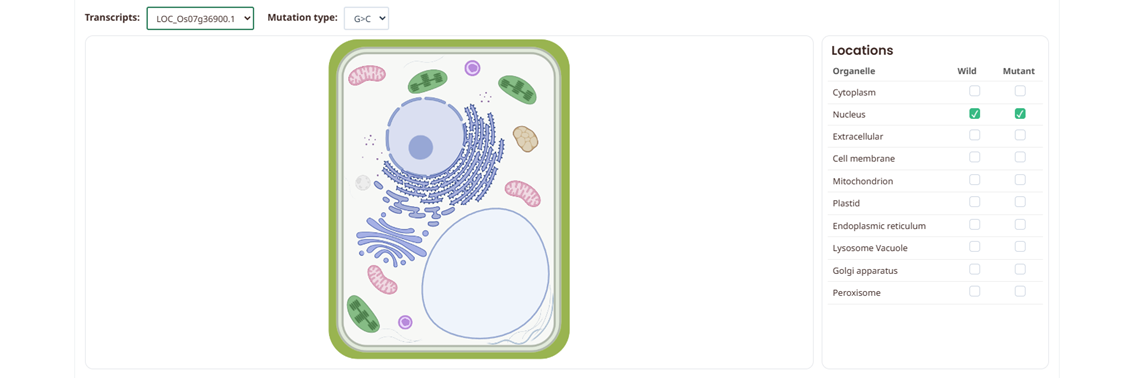
RiceVarMap v3.0 integrates genomic variation and functional annotations across three rice reference genomes: Nipponbare (IRGSP-1.0), Zhenshan 97 (ZS97RS3), and Minghui 63 (MH63RS3). It provides predictions of variant effects on chromatin accessibility across 25 tissue/developmental contexts, together with expanded annotations of protein localization, protein stability, and splicing effects. Population differentiation analyses and an AI-powered query assistant further support variant exploration and interpretation.
Try Web AI Chat
To further enhance user experience and support intelligent data exploration, RiceVarMap has now launched an interactive AI Chat service. This feature allows users to efficiently query complex genomic variations, functional annotations, and rice population information in an intuitive and conversational manner.
Visit RiceVarMap AI Chat

Explore RiceVarMap
A comprehensive resource for rice genomic variation and its functional annotationGenomic Variation
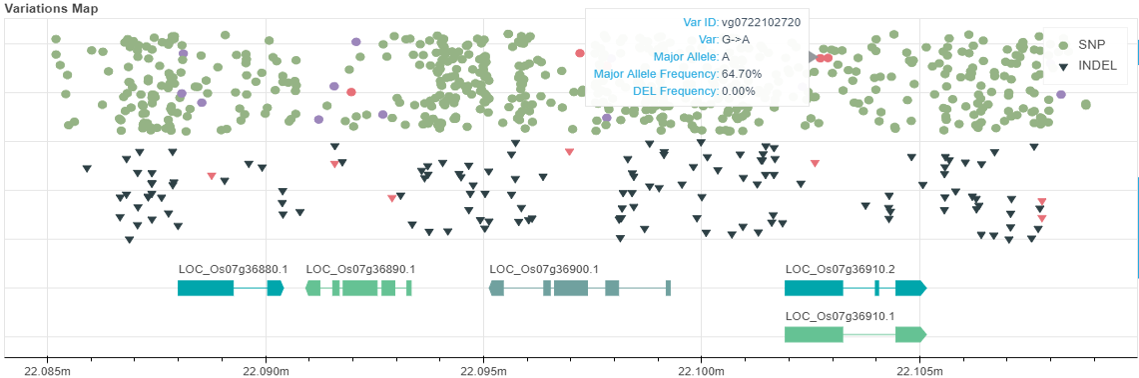
• Search by Region
• Search by Gene
• Genotypes by Variation ID
• Variation Information
• Polymorphic Sites
Cultivars & Phenotypes
• Cultivar Information
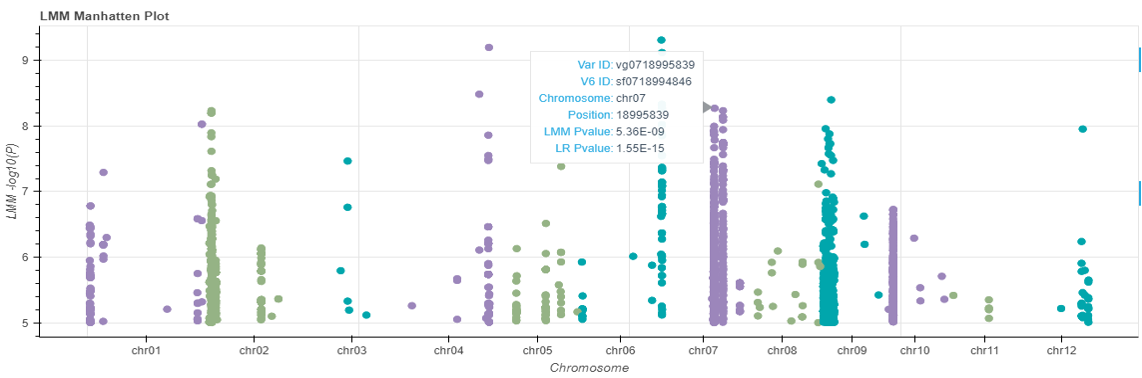
• Phenotypes & GWAS
Docs & Downloads
• Tutorial
• REST API
• Publications
• Notes and Data Evaluation
• Data Downloads
Versions
• RiceVarMap V1
• RiceVarMap V2
News
More ↗Integrated JBrowse genome browser
2026-08-12
JBrowse now enables interactive exploration of SNPs, InDels, gene annotations high-impact variants, and multi-tissue ATAC-seq and RNA-seq signals. Users can also open genomic regions directly from variant detail pages.
Usability and stability improvements
2026-06-07
User-reported issues with cultivar coordinates, haplotype downloads/plots, and material selection have been fixed.
RiceVarMap v3.0 released!
2026-01-15
Upgrades the platform to a multi-reference genome system (Nipponbare, ZS97, MH63) and expands population genetics and deep-learning–based variant annotations. An NLP-powered query assistant and optimized architecture further enhance analytical capability and performance.
Add STR information query
2024-09-16
Short tandem repeat (STR) data has been added to RiceVarMap2 as a type of genetic variant. It can be queried like other variant types and is available for bulk download on the download page. Special thanks to Dr. Xianrong Xie at SCAU for providing the data.
Add cultivar information query
2024-02-02
On the 'Search for Variation information by Variation ID' page, users can directly access the cultivation information corresponding to each genotype through the links in the table.
bug fix
2023-01-31
Fixed the error that less than 4 results could not be returned properly when designing primers. Thanks the users reported this bug.
bug fix
2022-12-09
Bug fixed: Fixed the problem that some gene IDs could not be queried in the database. Thanks Dr. Haifu Tu reported this bug.
download
2022-07-29
RiceVarMap now offers genotype files in VCF format and Plink format for download. Please visit Data Downloads page.
RiceNavi
2022-05-17
Rice quantitative trait nucleotides (QTNs) and inferred QTN effects were integrated into the RiceVarMap database. We thank Wei et al. for providing this very valuable information. Example
https
2022-03-16
RiceVarMap can be accessed using https://ricevarmap.ncpgr.cn
Features
High quality and complete genotype data. The genotypes of all accessions were imputed and evaluated, resulting in an overall missing data rate of <3% and an estimated accuracy greater than 99%. The SNP/INDEL genotypes of all accessions are available for online queries and download. To facilitate population genetic analysis, RiceVarMap also offers ancestral allele information and allele distribution data of subpopulations.
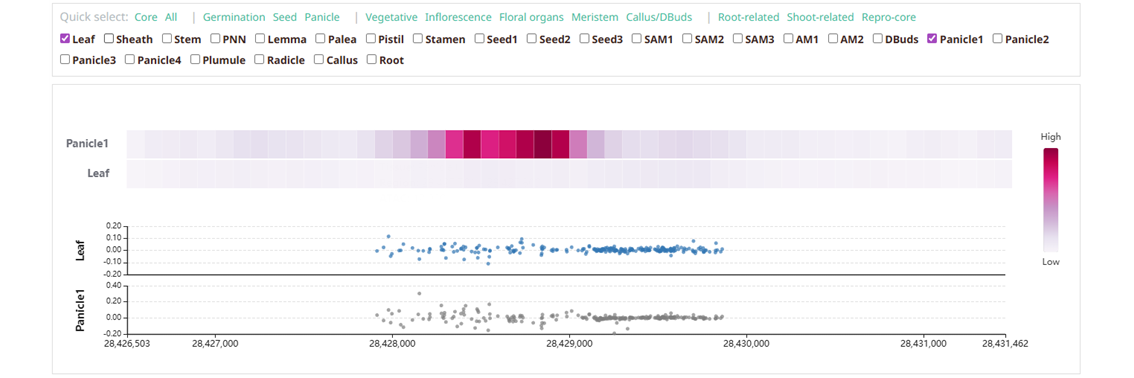
Comprehensive annotations of genomic variations. RiceVarMap now provides more precise variations and annotations. Haplotype-based approaches and conservatism of a segment in species were used to evaluate the impact of missense variations. For non-coding variants, RiceVarMap integrates genome-wide, tissue-specific chromatin accessibility profiles to characterize accessible regulatory regions across rice tissues. Based on these chromatin accessibility data, we trained sequence-based deep-learning models using Basenji (Kelley et al., 2018) to predict the effect of nucleotide sequences on chromatin openness. These models were trained on 25 tissue/developmental contexts. We then applied the trained models to variant sites identified in rice populations to prioritize variants that may affect cis-regulatory activity in different tissues.
Phenotype data and GWAS results. The database provides geographical details and phenotype images, agronomic and metabolic traits for some rice accessions. Plant scientists and breeders can also search for significant SNPs associated with various traits to develop useful molecular markers or pick up candidate genes.
New query methods and more tools. Besides all functions offered by RiceVarMap v1.0, we have designed more powerful visualization tools based on bokeh. Specifically, for non-coding variation, we provide an online prediction tool, Regulatory Variant Prioritization, users can query the effect of variants online by submitting variant IDs in the database or a VCF file.
Data Source
Genotype data
Currently, we collected sequencing data from three sets of rice germplasms consisting of totally 4,726 accessions of cultivated rice (Oryza sativa L.):
The first set of germplasm consisted of 533 accessions selected to represent both the usefulness in rice improvement and the genetic diversity in the cultivated species. We sequenced the 533 accessions using the Illumina HiSeq 2000 in the form of 90-bp paired-end reads to generate high-quality sequences of more than one gigabase per accession (>2.5x per genome, total 6.7 billion reads). These raw data are available in NCBI with BioProject accession number PRJNA171289. We provide phenotype images, agronomic and metabolic traits for these accessions.
The second set of germplasm was 950 rice accessions sequenced by Huang et al. (2012, Nat Genet, 44:32-39) that were downloaded from the EBI European Nucleotide Archive (accession number ERP000106 and ERP000729), which consists of 4.6 billion 73-bp paired-end reads (~1x per genome).
The third set of germplasm was 3024 rice accessions from The 3,000 Rice Genomes Project (2014, GigaScience, 3:7) that were downloaded from the EBI European Nucleotide Archive (accession number PRJEB6180), and unpublished resequencing data from 219 rice accessions, which has an average sequencing depth of 14x per genome.
Recognizing the limitations of using the Japonica reference genome (e.g., Nipponbare) for comprehensively analyzing variation unique to the Indica subgroup, RiceVarMap incorporates a specialized set of 4K genotype data derived from a cooperative project. This data was specifically aligned to the Indica reference genome (MH63RS3) to better capture Indica-specific genomic features. For this MH63-aligned dataset, we currently provide limited but high-value services crucial for comparative studies: subpopulation genotype and frequency queries, and non-coding region Basenji variant annotations.
Phenotype data and GWAS results
RiceVarMap V3.0 integrates phenotype and GWAS resources spanning eight studies, including six newly incorporated datasets. The phenotype catalog contains 59 distinct standardized non-metabolic traits, alongside the previously incorporated 840 metabolic traits. Users can explore these resources by trait, study, population and environment where available. Phenotype information is available on this page.
Chromatin accessibility data
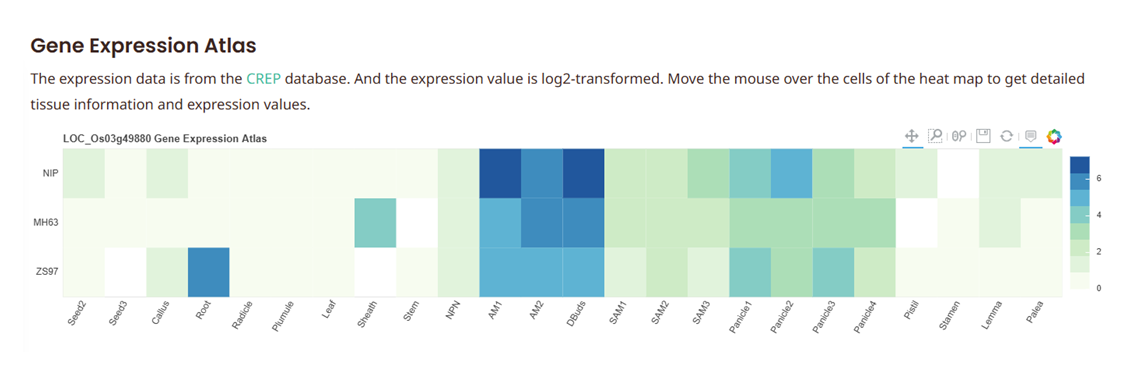
RiceVarMap integrates chromatin accessibility data from Zhu et al. (2024), covering 25 tissue/developmental contexts across Nipponbare, Minghui 63, and Zhenshan 97. This count represents the union of contexts across varieties; coverage varies by variety. The representative tissues include callus, radicle, plumule, leaf, leaf sheath, root, apical meristem (AM1/AM2), dormant buds (DBuds), shoot apical meristem (SAM1/SAM2/SAM3), panicle neck node (PNN), stem, young panicle (Panicle1/Panicle2/Panicle3/Panicle4), lemma, palea, pistil, stamen, and seed coat (Seed1/Seed2/Seed3). The experiments were conducted in three representative rice varieties, namely Nipponbare (NIP; japonica subspecies), Minghui 63 (MH63; indica subspecies type II), and Zhenshan 97 (ZS97; indica subspecies type I), with each experiment consisting of at least two biological replicates. In total, 146 genome-wide chromatin accessibility datasets were used as model targets in RiceVarMap V3.0.

Schematic of the 25 tissue/developmental contexts, adapted from Zhu et al. (2024).
Citations
Researchers who wish to use RiceVarMap are encouraged to refer to our publication or more:
Zhao H, Li J, Yang L, Qin G, Xia C, Xu X, Su Y, Liu Y, Ming L, Chen L-L, Xiong L and Xie W. An inferred functional impact map of genetic variants in rice. Molecular Plant. 2021, 14: 1584–1599
Zhao H, Yao W, Ouyang Y, Yang W, Wang G, Lian X, Xing Y, Chen L and Xie W. RiceVarMap: a comprehensive database of rice genomic variations. Nucleic Acids Research. 2015, 43(D1): D1018-D1022
Comments or Questions
For any questions, please contact Le Zhang at lezhang@webmail.hzau.edu.cn .